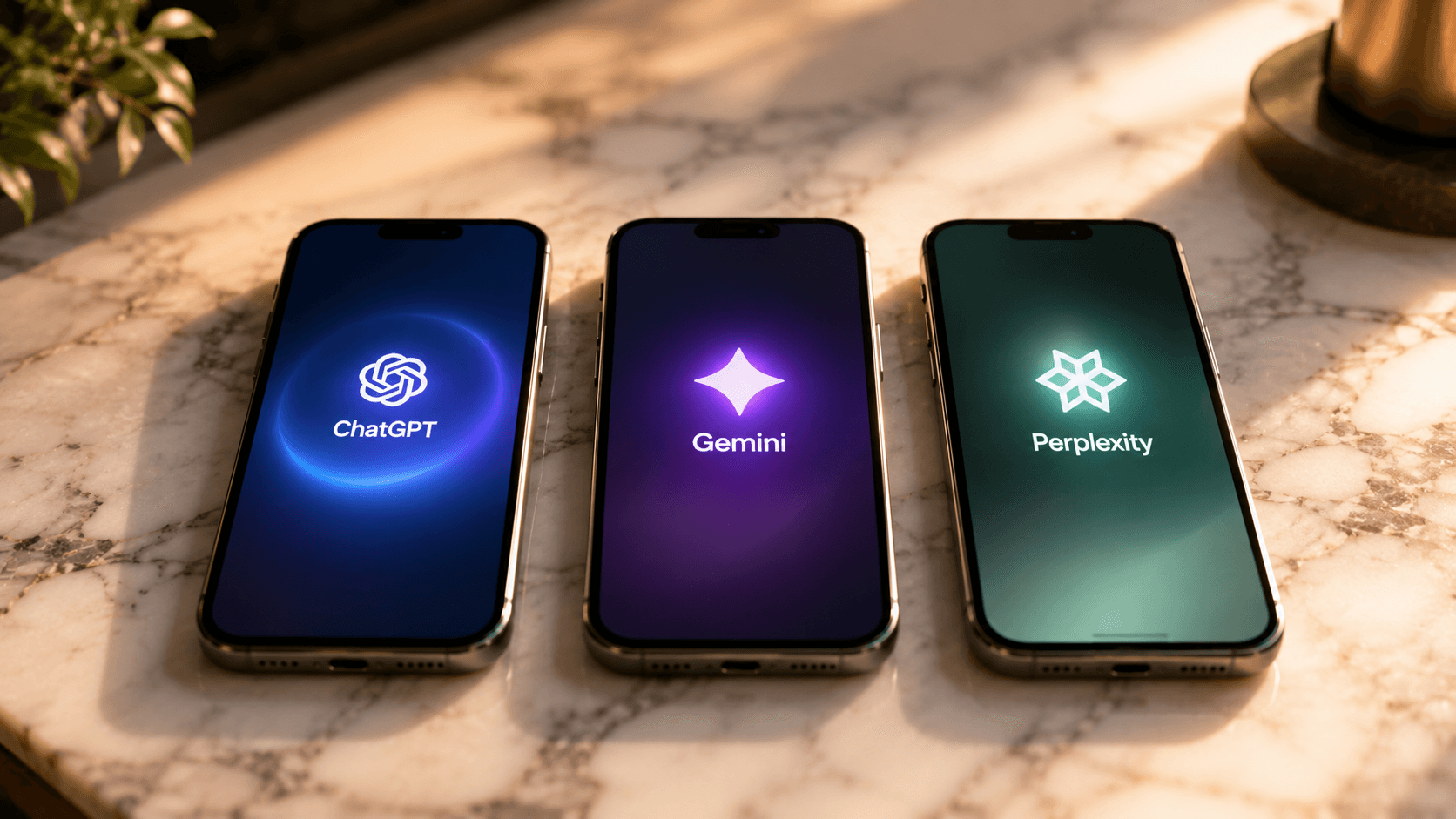
Three major AI engines. Three different recommendation logics. Most businesses optimize for none of them. Here is what sets each platform apart — and where your effort actually pays off.
Three engines, three recommendation logics
By mid-2026, the majority of commercial research journeys begin with a generative answer rather than a list of blue links. But "generative search" is not one thing. ChatGPT, Perplexity, and Google AI Overviews each work differently under the hood — and they surface businesses differently as a result.
Most operators treat them as interchangeable and optimize for none of them deliberately. The ones who understand the differences build visibility that competitors cannot easily replicate. This is a practical breakdown of how each platform decides what to recommend, where the shared signals live, and what you can do that is specific to each.
Google AI Overviews
Google AI Overviews sit on top of the world's most established knowledge graph. When a query triggers an Overview, Google is not starting from scratch — it is synthesizing an answer from sources it has already indexed, crawled, and evaluated through years of trust-signal accumulation.
How it decides what to surface
Entity recognition is the foundation. Google has spent years building a formal understanding of which businesses exist, what they do, and how authoritative they are. Businesses with a Google Knowledge Panel — a signal that Google has formally admitted them into the Knowledge Graph — get cited in Overviews far more readily than those that exist only as websites.
Structured data carries outsized weight here. Organization schema, LocalBusiness schema, and a well-populated sameAs array explicitly tell Google's systems which entity your site represents. This is the machine-readable layer Google built its ecosystem around; Overviews inherit that trust signal directly.
E-E-A-T — Experience, Expertise, Authoritativeness, Trust — remains a primary filter. Overviews favor sources Google has evaluated as high-quality: pages with clear authorship, verifiable expertise, strong inbound signals, and a clean technical footprint. The same signals that drove traditional rankings now feed the answer layer.
What to do specifically for Google AI Overviews
Claim and fully complete your Google Business Profile — it feeds Overviews directly for local and commercial queries. Implement Organization and, where relevant, LocalBusiness schema site-wide. Pursue a Knowledge Panel if your business warrants one: consistent NAP everywhere, verified profiles, and corroborating third-party mentions are the path. Keep your E-E-A-T signals strong: named authorship, founder visibility, and structured content that answers real questions.
Perplexity
Perplexity operates as a retrieval-first engine. When a user submits a query, it performs a live web search, reads the results, and synthesizes an answer from what it finds in real time. It shows its sources explicitly — citations are the product, not a footnote.
How it decides what to surface
Citation velocity matters more here than on any other platform. Because Perplexity is pulling live results for every query, freshness and web coverage are disproportionately powerful. A business mentioned recently across several credible sources is one Perplexity can confidently pull from. A business with few live references is one it has little to work with.
Content extractability is equally important. Perplexity is reading your page in real time and deciding whether to pull from it. Clean HTML structure, clear headings, FAQ content with explicit question-and-answer pairs, and pages that directly state their subject all make you easier to cite. Opaque, marketing-heavy pages that require inference give Perplexity less to grab.
Perplexity also weights domain authority and source credibility when deciding which of several retrieved pages to cite. Third-party mentions in credible publications, industry directories, and authoritative domains amplify your coverage in ways that matter here specifically.
What to do specifically for Perplexity
Build citation velocity through genuine third-party coverage: press mentions, industry directories, partner announcements, and guest contributions all create the live web presence Perplexity can retrieve. Structure your pages for extraction: clear h2 and h3 headings, FAQ sections with explicit Q&A format, and first-person specificity that proves this content comes from somewhere real. Keep your pages current — Perplexity reads live, so freshness directly affects visibility in a way it does not for engines that rely more on training data.
ChatGPT
ChatGPT has two layers that operate differently and reward different signals. The training layer is what the model learned during its last training cycle — a broad, deep representation of the web's text as it existed up to the cutoff date. The browsing layer is what the model retrieves live when a user's query signals that current information is needed.
How it decides what to surface
Training-layer recognition determines the baseline. Businesses that appeared substantively in the web's text during the training period — covered in articles, referenced across credible sources, discussed in industry publications — have a presence in the model's weights. When a user asks about a category and no browsing is triggered, the model recommends from what it knows. This is why older, well-documented businesses sometimes appear in ChatGPT answers without having done any AI-specific optimization: they were simply present in the training data.
For newer businesses, or for queries where ChatGPT's search layer activates, the live retrieval dynamic is closer to Perplexity: structured, extractable content and fresh third-party coverage matter significantly. The difference is that ChatGPT's search layer is less retrieval-obsessive than Perplexity's — it is more willing to synthesize from training knowledge alongside retrieved content, so entity authority from training still feeds the answer even when browsing is active.
Memory and personalization are factors that neither Google nor Perplexity have at the same scale. Users who interact with ChatGPT regularly may receive recommendations shaped by their prior conversations and stated preferences, which is a dynamic that is currently impossible to optimize for directly — it is a reason to ensure the factual signals the model encounters about your business are accurate across every touchpoint.
What to do specifically for ChatGPT
Pursue the third-party coverage and authoritative mentions that build training-layer presence over model cycles. This is a long-horizon investment: earning mentions in publications the model is likely to have ingested builds recognition that persists across queries even when no live search is triggered. Simultaneously, structure your owned content for the live layer: clean pages that answer real questions directly, updated regularly, with schema that makes extraction clean. Maintain accurate information everywhere your business appears — the model synthesizes from multiple sources, and contradictions degrade how confidently it describes you.
The shared foundation
Despite their differences, the three platforms reward a common underlying infrastructure.
Entity clarity — a consistent, verifiable identity across the web — is the prerequisite for confident citation on any platform. A business the engines cannot confidently resolve as a single entity is one they route around.
Structured data is universally beneficial. The degree varies by platform, but clean schema removes ambiguity for all of them.
Review signals — velocity, recency, sentiment — are read as live trust indicators across all three, and their absence is conspicuous in competitive categories.
Citation and mention coverage in credible third-party sources feeds the retrieval layer of every platform and builds the training-layer presence that accumulates across model cycles.
This is why optimizing for one engine is rarely worth the tradeoff: the underlying signals that lift your visibility in Google AI Overviews are the same signals that make you extractable in Perplexity and present in ChatGPT's training and retrieval layers. Build the foundation, and you improve across all three simultaneously.
Where to focus your effort
If you had to prioritize: Google AI Overviews for the broadest reach and highest commercial query volume; Perplexity for research-heavy buyer journeys where the consideration process is longer and more rigorous; ChatGPT for conversational discovery, where buyers are asking for guidance rather than comparison-shopping.
The practical answer for most businesses is to treat the shared signals as the primary investment — entity clarity, schema, reviews, citation coverage — and add the platform-specific tactics as multipliers on top of that foundation. Do the foundation work first. The platform-specific details reward businesses that have already earned the right to be cited.
ChatGPT, Perplexity, and Google AI Overviews are meaningfully different systems with meaningfully different recommendation logics. Understanding those differences tells you where to place your platform-specific bets. But the most durable AI visibility strategy is the one that builds the shared foundation — entity clarity, structured data, reviews, citation coverage — that lifts your position across all three at once. Earn the right to be cited, then optimize how you show up in each platform's particular way of deciding who belongs in the answer.
Related from Hey Pearl
Frequently Asked Questions
Which AI engine sends the most traffic to business websites?
Google AI Overviews currently reach the broadest audience by volume, since they appear on a large share of Google searches. However, traffic volume from AI citations is less predictable than from ranked links — AI engines often answer without a click. Perplexity sends more direct referral traffic per citation because it shows sources explicitly, while ChatGPT and Gemini traffic varies by whether users follow cited links.
Read full answerDo I need to optimize for each engine separately?
The core work is shared: entity consistency, schema, reviews, and citation coverage lift you across all three simultaneously. Platform-specific tactics — like pursuing Google Knowledge Panel status for AI Overviews, or building Perplexity-readable page structure — are multipliers on a solid shared foundation, not substitutes for it. Start with the shared signals; layer platform specifics on top.
Read full answerWhy does ChatGPT sometimes recommend businesses that have never done any optimization?
ChatGPT's training layer contains a representation of the web's text up to the model's training cutoff. Businesses that were substantively discussed in credible online sources during that period have a presence in the model's weights, which the model draws on when answering category queries without triggering a live search. Older, well-documented businesses benefit from this; newer or less-documented ones need to build the live web presence that the retrieval layer can access.
Read full answerIs Perplexity important if my buyers aren't technically sophisticated?
Perplexity's user base skews toward research-heavy buyers — professionals, analysts, and anyone conducting serious comparison research — so it matters most for categories with longer consideration cycles: B2B services, professional practices, high-ticket consumer decisions. If your buyers tend to make quick decisions on familiar terms, Google AI Overviews and ChatGPT likely carry more weight.
Read full answerHow do I know which engine my buyers are using?
Check your analytics for referral traffic labeled with AI engine domains, and ask customers directly how they found you. Anecdotally, business buyers frequently use ChatGPT and Perplexity for vendor research; consumer buyers lean more on Google AI Overviews and voice search assistants. The honest answer is that most buyers use several, which is why platform-agnostic signal building is the right default strategy.
Read full answerCan paid advertising on these platforms replace organic AI visibility?
Paid placements exist or are emerging on some platforms, but they occupy a different position from organic citations — users who trust AI recommendations specifically trust them because they appear earned rather than purchased. The organic answer layer is where discovery-stage influence lives, and it responds to authority signals, not budget. Paid and organic serve different moments in the buyer journey rather than substituting for each other.
Read full answerBuild the authority AI engines trust.
Hey Pearl builds the authority infrastructure that gets your business cited, recommended, and remembered by AI search engines.